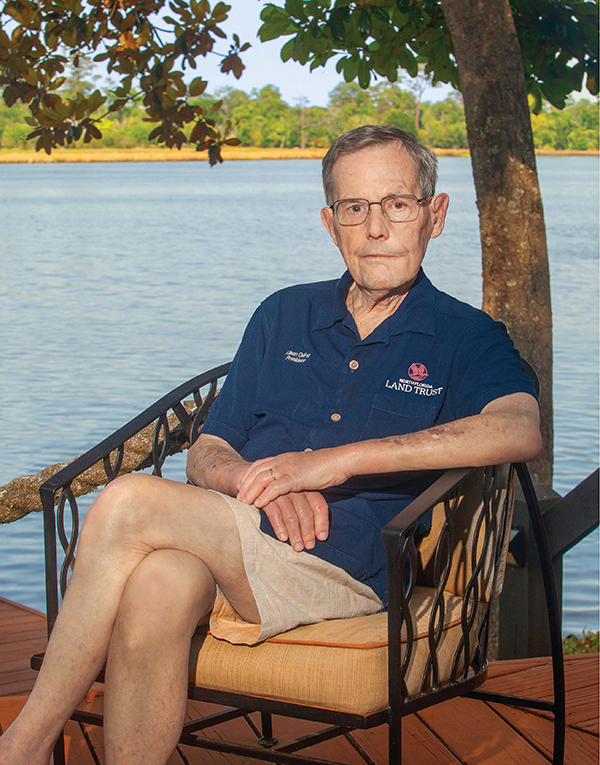
The Conversation: Allison DeFoor
President/CEO North Florida Land Trust
If North Florida’s natural lands disappeared tomorrow, what would people notice first and what would they lose that they might not expect?
The first thing people would notice is water. North Florida’s forests, wetlands, and marshes filter and protect the water we drink every day. Without them, you would see declines in water quality and quantity almost immediately. What people might not expect to lose is something like shrimp and grits. Our fisheries, estuaries, marshes, and working waterfronts all depend on healthy natural systems. Conservation is not separate from our way of life here; it is what sustains it, and us all.
We often think of conservation as “nice to have.” What would you say to someone who doesn’t realize how directly it impacts their daily life, especially here in North Florida?
In Florida, most people already understand that conservation directly impacts their daily lives. We see it in the overwhelming voter support for conservation referenda across the state. People understand that clean water, access to nature, wildlife, fishing, and protection from flooding are not luxuries; they are essential to our quality of life and economy. County after county have passed local bonds and Floridians passed Amendment 1 with 75 percent of the vote statewide.
North Florida’s natural environment is part of our identity. It is why people choose to live here and why visitors come here. In many ways, Florida’s outdoors is part of our DNA. Even Disney World and SeaWorld replicate Florida’s natural beauty in an artificial environment because they understand how deeply people connect to it.
North Florida is changing quickly. What are you seeing on the ground right now that makes this moment especially urgent for conservation?
Last year, we took a group of donors to a property between Penney Farms and the new First Coast Expressway. Standing in the back of a pickup truck, we looked one direction and saw forests and open land. Then we turned the other way and saw bulldozers building the new interchange.
That is how immediate this moment is. The line between what gets protected and what gets developed is no longer theoretical, it is right in front of us. The decisions being made today will shape North Florida forever. Once land is developed, we do not get the opportunity to change our minds later. It’s now or never!
What’s a recent conservation win that proves what’s possible and what would have been lost if that land hadn’t been protected?
DeerCreek Plantation is a powerful example. Located near the intersection of several major highways, that entire area is rapidly developing and will likely look very different in the coming years. But a forward-thinking landowner, the Ringhavers, chose to permanently protect nearly 2,000 acres through conservation. That decision means those trees, wetlands, wildlife habitats, and working lands will remain intact forever—not just for today, but for future generations. It is a reminder that conservation is ultimately about long-term vision and recognizing what is worth protecting before it disappears.
How should business leaders and policymakers be thinking about conservation differently right now?
Business leaders increasingly recognize that natural lands are not obstacles to economic growth. They instead are assets that make communities stronger, more desirable, and more profitable. Conservation protects drinking water, reduces flooding, supports tourism and recreation, and helps preserve the character that attracts both businesses and residents to North Florida.
Central Park is a classic example. Its value is not just environmental; it also elevates the surrounding economy and quality of life. The same principle applies here. Protected natural spaces are part of the infrastructure that makes communities resilient, healthy, and economically competitive.
If every reader could take one action this year to help protect North Florida’s natural lands and waters, what would you want it to be and why now?
Get involved now. Join North Florida Land Trust, support conservation organizations, speak up for protecting natural lands, and help people understand what is at stake.
This moment is urgent because North Florida is changing rapidly. The decisions we make today will determine whether future generations inherit forests, farms, wetlands, wildlife, and clean water … or simply memories of them. As I said, it is now or never.
What do you love most about Jacksonville?
Randy DeFoor most of all.
Combined with the river, the parks, and the proximity to the beaches, Jacksonville creates a quality of life that is hard to match. It is a city with real momentum and real opportunity, and that makes it an exciting place to be.