By Wayne W. Wood
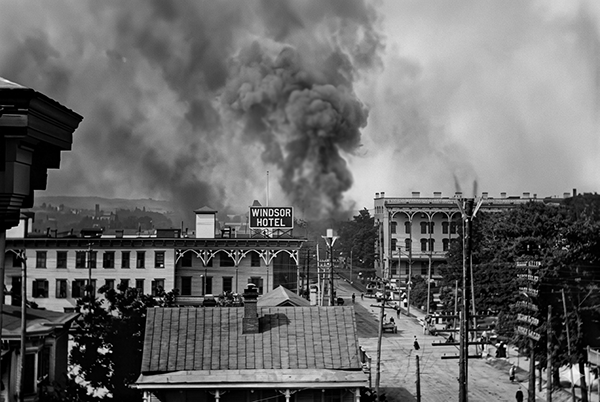
Most people in Jacksonville have heard about the Great Fire of 1901, but few know the story of how it all started.
It began on Friday, May 3, 1901. Not much was happening in Florida’s largest city, population 28,000. The weather report had not changed for weeks—hot and dry.
In the LaVilla suburb west of town, workers at the Cleaveland Fiber Factory were taking a break for the noonday meal. Located diagonally across from where the Ritz Theatre is today on Davis Street, this large factory had a 200-foot-long elevated wooden drying platform, where tons of Spanish moss were curing after being washed and combed with a cotton gin. These fine fibers were used to make mattress stuffing. Due to the flammability of the moss, it was the custom to have a man on duty to watch for cinders from the chimneys of nearby shanties. But on this day, since there was no wind, the watchman went to lunch with his friends.
The workers ate their lunch, and then they lay down in the soft piles of moss fibers to take a nap. When the Great Fire of Jacksonville began, they were asleep!
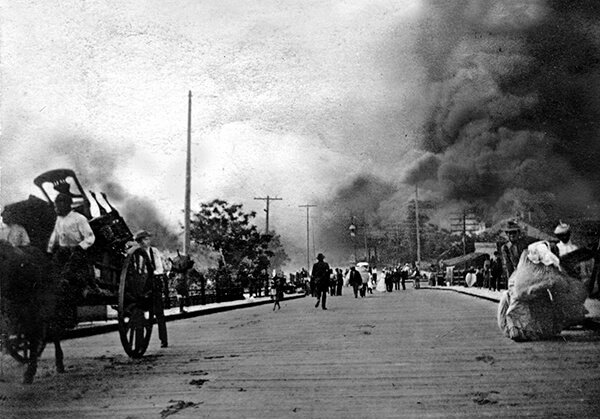
An errant ember from a nearby cook stove landed on the moss and ignited the fibers, just as a gust of wind came up, rapidly spreading the flames across the wooden platform. By the time workers noticed the blaze, their meager buckets of water were no match for the wind-fueled inferno. The fire roared through the moss bed and into the three-story factory building, where more moss, chicken feathers, horsehair, palmetto fronds, and cotton were packed tightly into bales. This entire factory was constructed of pitch pine, making it perhaps the most potent incendiary device ever created in Jacksonville. The torrent of flames raced through the building, and KERBOOM! the factory exploded, casting millions of burning embers into the sky.
Within minutes, Fire Chief Thomas W. Haney and his men arrived at the mattress factory. It was engulfed in flames so hot they could not get near it. They ripped doors off nearby houses to use as shields, but as they tried to get closer to battle the blaze, the heat was so intense their hoses caught fire and burned with water streaming through them. Burning debris filled the air. Chief Haney turned and looked back to the east. To his horror, countless bits of flaming moss were falling from the sky like rain onto the rooftops across the city. Jacksonville was burning down behind him.