By Wayne W. Wood
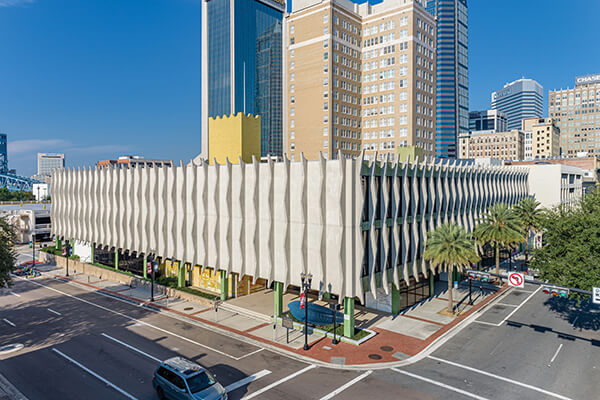
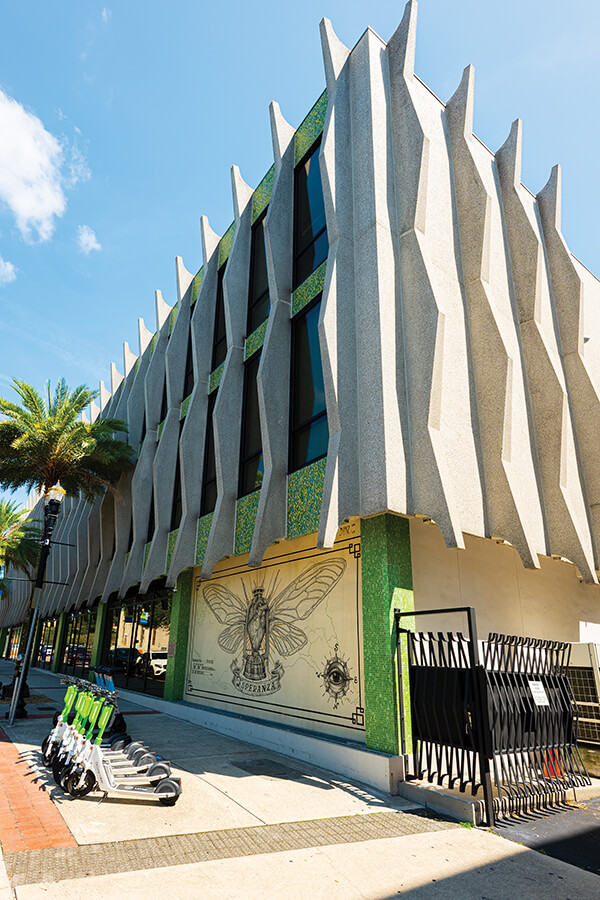
A century from now, when architectural historians come to visit Jacksonville, one of the four most important buildings they will want to see is the former Haydon Burns Library, aka The Jessie.
(The other three would almost surely be the St. James Building, Gulf Life tower, and Chart House.)
The fact that the old library building still exists is a miracle in itself. Like many of the buildings in downtown Jacksonville, it is interwoven with the story of destruction and rebirth.
On May 3, 1901, 90 percent of downtown was decimated in a great fire. Shortly after the fire, New York architect Henry John Klutho moved to Jacksonville to help rebuild the city. One of his first commissions was to design Jacksonville’s new city hall, to replace the former one destroyed by the blaze. On March 3, 1903, the new city hall was completed and opened with great fanfare. It featured a stately limestone façade with paired Ionic columns and was crowned with a 40-foot-diameter copper dome. Its neoclassical style was the latest fashion. It was the pride of the city.
Sixty years later, Klutho’s city hall was outmoded and cramped for space. Its classical architecture was old-fashioned and out of style. It was demolished to make way for Jacksonville’s newest, most ultra-modern building, the Haydon Burns Public Library. The library’s architecture was state-of-the-art, and the building quickly became the pride of the city.
The new library was designed by Taylor Hardwick, one of several young architects that came to Jacksonville after World War II who were devoted to a sense of modernistic design and passionate about the possibilities of innovative new building materials.
The new library was like nothing else the city had ever seen. Its façade featured 88 cast-concrete sculpted fins, each 19 feet tall, which mimicked the windswept profiles of popular automobiles of the era. The fins created ever-changing shadow patterns and added to the harmonic, almost musical rhythm of the exterior. (Hardwick liked to point out that the number of fins on the library was the same as the number of keys on a piano.)