The City As An Instrument
Where music history refuses to stand still
By Sheri Webber
PRELUDE
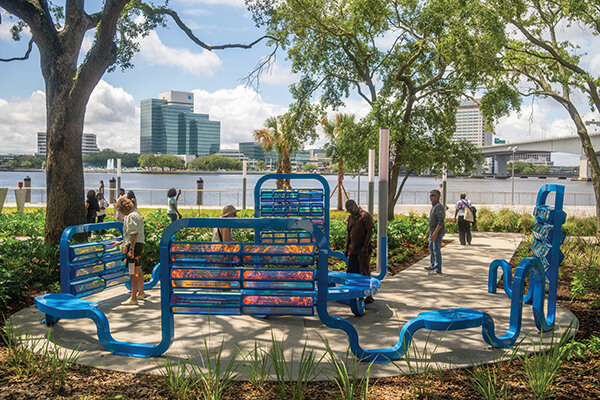
Step onto Jacksonville’s Northbank Riverwalk behind the Jacksonville Center for the Performing Arts and the city’s musical history is suddenly underfoot, overhead, and all around.
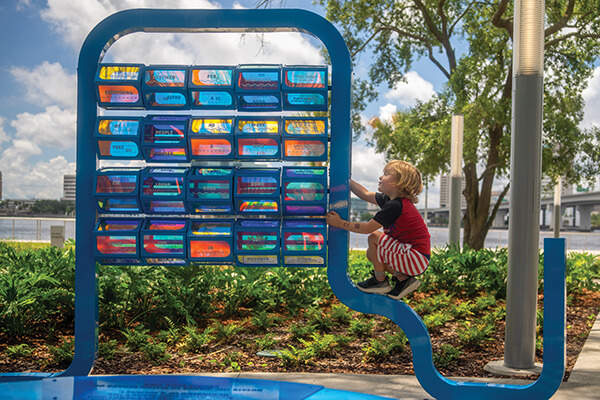
Names are embedded in the landscape. Lyrical fragments catch and change with the light. Take a few steps more and a familiar song emerges. Move again and its parts may rearrange. Another visitor enters the space and the composition changes again.
This is the Riverfront Music Garden, a new public space devoted to a musical legacy that stretches across generations and stubbornly resists conforming to a single genre.
Here’s the gist, the skinny, the staccato: Jacksonville built a monument to music. That can’t. Stay. Still.
OVERTURE
Long before Jacksonville became shorthand for Southern rock, the city was already sending music far beyond the banks of the St. Johns.
Consider just five of the 30 names included in the Music Garden’s totemic Walk of Fame: Delius, Chappelle, Hoss, Jones, and Sweet.
In 1884, 22-year-old Frederick Delius arrived on the St. Johns River less as a composer than as a reluctant businessman. His father, a prosperous English wool merchant who disapproved of his musical ambitions, had sent him to Florida to manage an orange plantation at Solano Grove in present-day St. Johns County. Delius proved considerably more interested in music than citrus. He studied with Jacksonville organist Thomas Ward and, more consequentially, became captivated by the songs of the African American workers around him—their rhythms and harmonies rooted in African musical traditions. That revelatory landscape of sound helped shape his emerging musical voice and would echo through later works, including his Florida Suite. What was intended as an apprenticeship in business instead confirmed Delius’s desire to pursue a life in music. His Solano Grove cottage survives today on the Jacksonville University campus—a physical remnant of an unlikely Florida interlude that helped set the young Delius on the path to becoming one of England’s notable classical composers.

A generation later, Pat Chappelle, born in Jacksonville in 1869, emerged from LaVilla to become a pioneering Black entertainment entrepreneur. His Rabbit’s Foot Company carried Black musicians and performers across the South, while his Excelsior Concert Hall was among the earliest Black-owned theatrical venues in the region. The venues themselves have vanished, casualties of a once-dynamic hub dramatically altered over the ensuing century, but the neighborhood remains a geographic marker of a cultural influence far larger than its footprint.